
EMISSIONS & AIR QUALITY GUIDE
Volatile organic compounds (VOCs) are the invisible chemicals that give a new car its smell, make fresh paint sting your eyes and slowly escape from plastics, adhesives, foams and coatings. If you make, buy or approve any of these materials, sooner or later a customer, an OEM or a regulator will ask you to test for VOCs and prove your product is within limits.
The challenge is that there is no single “VOC test”. The right method depends on what you are testing — a car interior part, a can of paint, a room’s air or a water sample — and on which standard your customer has written into the specification. This guide explains, in plain language, how to test for VOCs correctly: the main methods, the standards behind them, how a lab actually runs the test and how to choose the approach that fits your product.
Your complete guide to VOC test methods, standards and lab procedure
VOCs are carbon-based chemicals that evaporate easily at room temperature. Common examples include toluene, xylene, benzene, formaldehyde, acetaldehyde, styrene and a long list of solvents, plasticisers and monomer residues. They come from paints, varnishes, adhesives, sealants, PU foams, PVC and TPO skins, carpets, rubber parts, inks, cleaning products and even some electronics.
Inside a closed space such as a car cabin, an office or a home, these compounds build up. Short-term exposure can cause headaches, eye and throat irritation and the familiar "new smell"; some VOCs, such as benzene and formaldehyde, are recognised as hazardous at higher exposures. On the manufacturing side, high-VOC materials also cause windscreen fogging, odour complaints and failed OEM approvals. That is why automotive OEMs, paint buyers, furniture brands and green-building programmes all ask suppliers to test for VOCs before a material is approved.
There are seven proven ways to test for VOCs, ranging from a quick on-site reading to a full laboratory analysis that names every compound. Screening tools tell you whether there is a problem; laboratory methods tell you exactly what the problem is and whether it meets your specification.
A handheld photo-ionisation detector gives a quick total VOC (TVOC) reading in ppb or ppm. Fast and low cost, but it cannot tell you which compounds are present.
Emissions are trapped on sorbent tubes (typically Tenax TA), then released by heat into a GC-MS that identifies and quantifies each compound. The reference method for automotive and indoor-air work.
The sample is sealed in a vial and heated; the vapour above it is injected into a GC. Used for total carbon emission of interior materials.
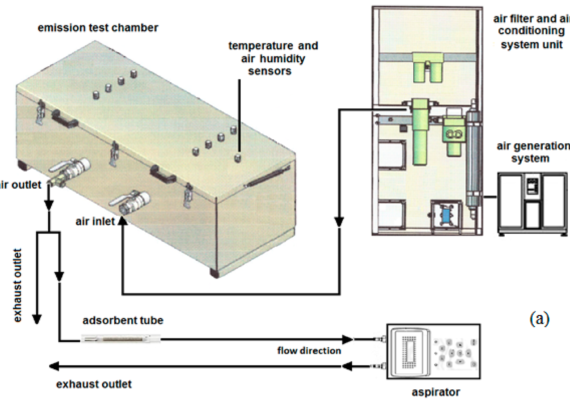
Small or micro-chambers hold the material at controlled temperature, humidity and air exchange, so results reflect real-life emission rates in µg/m²h.
A complete component is sealed in an inert sampling bag, heated and purged, and the air is sampled for VOCs and carbonyls. Ideal for whole parts and assemblies.
For paints, inks and adhesives, the volatile content is measured gravimetrically or by GC and reported in g/L, the unit used in paint VOC regulations.
Formaldehyde and acetaldehyde are captured on DNPH cartridges and analysed by HPLC-UV, because they are poorly detected by standard GC-MS methods.
When you send a part to a laboratory to test for VOCs, the result is only as good as the sample and the procedure. A typical workflow looks like this:
Identify the standard named in your drawing, OEM specification or tender (for example VDA 278 or ISO 16000-9) and the pass/fail limits.
Take fresh samples from regular production, wrap them in aluminium foil, seal them in a clean polyethylene bag and send them quickly — delays and poor packing change the results.
The lab cuts or prepares the specimen to the size the standard requires and conditions it at controlled temperature and humidity.
Depending on the method, the specimen is heated in a desorption tube, a headspace vial, a bag or an emission chamber for a fixed time.
Released compounds are collected on sorbent tubes or DNPH cartridges and analysed by GC-MS, GC-FID or HPLC against calibrated standards.
Results are expressed in the units the standard requires — µg/g toluene equivalent, µgC/g, µg/m³ or g/L — with individual compounds listed.
The report is checked against your specification so you know clearly whether the material passes, fails or needs a process change.
Most VOC specifications reference one of a small family of international standards. Knowing which one applies tells you the sample size, the test temperature, the analysis technique and the units your results will be reported in.
VDAISO 12219ISO 16000ENASTMDIN
| Standard | What It Covers | Typical Use |
|---|---|---|
| VDA 278 | Thermal desorption GC-MS of VOC and FOG (semi-volatile) emissions from non-metallic materials | Automotive interior plastics, foams, textiles, adhesives |
| VDA 277 | Headspace GC determination of total carbon emission | Automotive interior materials |
| ISO 12219-2 | Bag method for VOC and carbonyl emissions from whole components | Dashboards, seats, door trims, assemblies |
| ISO 12219-3 / -4 | Micro-chamber and small-chamber screening of interior materials | Automotive material development and comparison |
| ISO 16000-6 | Sampling on Tenax TA and TD-GC-MS analysis of VOCs in air and chambers | Indoor air, building products |
| ISO 16000-9 | Emission test chamber method for building products and furnishing | Flooring, panels, furniture, sealants |
| ISO 16000-3 | Formaldehyde and other carbonyls by DNPH / HPLC | Indoor air, chamber air, wood-based panels |
| EN 16516 | Harmonised method for release of dangerous substances to indoor air | Construction products in Europe |
| ASTM D5116 | Small-scale environmental chamber determination of organic emissions | Indoor materials and products |
| ISO 11890-1 / -2 | VOC content of paints and varnishes (difference and GC methods) | Paints, coatings, varnishes |
| ASTM D2369 | Volatile content of coatings | Paints, inks, adhesives |
| DIN 75201 / VDA 270 | Fogging behaviour and odour assessment (related tests) | Automotive interiors |
Always use the exact standard and edition named in your customer's specification. Results from different methods — for example VDA 278 and ISO 12219-2 — are not directly comparable, even on the same material.
The fastest and most cost-effective way to test for VOCs is to start from your end requirement rather than from the instrument. Use this quick guide:
If you do not yet have a specification, our team can review your application, recommend a method and suggest realistic limits based on your industry.
Kiyo R&D Lab supports manufacturers, suppliers, contractors and students across Tamil Nadu and the rest of India from two locations:
Our main laboratory in Chitlapakkam, Chrompet, serving Chennai city, Guindy, Ambattur, Tambaram and nearby industrial estates.
Call UsWhatsApp UsClose to the Oragadam and Sriperumbudur automotive and electronics belt, ideal for Tier-1 and Tier-2 suppliers who need quick sample drop-off.
Call UsWhatsApp UsExplore all our capabilities at www.kiyorndlab.com.
Whether you need a quick screening check or a full OEM approval report, the right way to test for VOCs starts with the right standard, careful sample handling and a lab that explains what the numbers mean. Getting this right first time saves repeat testing, delayed approvals and unhappy customers.
Share your product details and specification with Kiyo R&D Lab. Our team will recommend the most suitable method, confirm cost and turnaround, and guide you from sample packing to final report — from Chrompet, Chennai or Oragadam, Sriperumbudur.
Still have a question? Call us or message us on WhatsApp.