Industrial Fabric Testing Services

Unmatched Industrial Fabric Testing Services – Kiyo R&D LAB’s High-Accuracy Strength & Durability Evaluation

Introduction

Industrial fabrics are no longer simple woven materials. They are engineered, performance-driven textiles designed to survive extreme conditions—heavy loads, harsh weather, chemicals, abrasion, and continuous movement. From conveyor belts and filtration fabrics to geotextiles, tarpaulins, safety harness straps, and coated technical textiles, these materials are expected to work reliably without failing.

The only way to know if an industrial fabric will actually perform as promised is to test it scientifically. That’s where industrial fabric testing services – Kiyo R&D LAB come in. As a NABL-accredited laboratory, Kiyo R&D Lab provides a complete range of tests to evaluate the strength, durability, stability, and overall suitability of industrial and technical fabrics for demanding applications.

Ultimate Industrial Fabric Testing Services – Kiyo R&D LAB’s NABL-Certified Performance Analysis

Why Industrial Fabric Testing Really Matters

Industrial fabrics are often used in critical roles—supporting loads, containing materials, protecting workers, filtering process fluids, or reinforcing structures. If they fail, the consequences can be serious:

  • Production downtime and costly equipment damage
  • Safety risks to workers or end users
  • Leakage, contamination, or product loss
  • Premature wear, tearing, or bursting in the field
  • Customer complaints and rejected shipments

Proper testing answers key questions such as:

  • Will the fabric tear or burst under load?
  • Can it withstand repeated bending, flexing, and abrasion?
  • Will it degrade quickly in sunlight, moisture, or chemicals?
  • Is it suitable for the specified safety or industrial standard?
  • Is the quality consistent from batch to batch?

With industrial fabric testing services – Kiyo R&D LAB, you replace guesswork with data that you can show to buyers, auditors, and certification bodies.

Who Needs Industrial Fabric Testing?

Many sectors depend heavily on reliable fabric performance. Typical users of Kiyo R&D Lab’s industrial fabric testing include:

  • Technical textile manufacturers – to develop new products, refine constructions, and certify quality.
  • Construction & geotechnical companies – for geotextiles, erosion control fabrics, and soil reinforcement materials.
  • Automotive & transport – airbags, seat fabrics, tarpaulins, duct covers, insulation layers, and acoustic barriers.
  • Safety and PPE manufacturers – harness straps, industrial suits, gloves, fall protection and fire-retardant fabrics.
  • Filtration & process industries – filter media, belt filters, and high-temperature or chemical-resistant fabrics.
  • Packaging & bulk handling – FIBC bags, woven sacks, cargo covers, and industrial wraps.
  • Agriculture & aquaculture – shade nets, pond liners, greenhouse and protection fabrics.
  • Oil, gas & marine – coated fabrics, barriers, and heavy-duty protective covers.

In all these applications, fabric failure is not just an inconvenience—it can mean real financial and safety consequences.

Key Industrial Fabric Tests at Kiyo R&D Lab

Kiyo R&D Lab performs tests according to ASTM, ISO and relevant BIS standards, using calibrated, high-precision instruments. Here are some of the most important tests offered under industrial fabric testing services – Kiyo R&D LAB:

1. Tensile Strength & Elongation

Tensile testing measures how much force is required to pull the fabric apart and how much it stretches before breaking. This is critical for:

  • Conveyor belts and reinforcement layers
  • Safety harness straps and lifting slings
  • Tarpaulins, covers, and tensioned fabric structures
  • Geotextiles and industrial reinforcement fabrics

2. Tear Strength

Tear testing evaluates resistance to the propagation of an existing cut or hole. This matters when fabrics may get nicked, punctured, or cut in service. High tear strength is especially important for:

  • FIBC bags and woven sacks
  • Heavy-duty packaging and cargo fabrics
  • Geotextiles used in soil stabilization
  • Protective clothing and safety equipment

3. Bursting Strength

Bursting tests subject the fabric to multi-directional pressure until it fails. This test is essential for:

  • Industrial bags and bulk packaging
  • Filter fabrics under pressure
  • Elastic and knitted technical fabrics
  • Protective covers and diaphragms

4. Abrasion Resistance

Many industrial fabrics face constant rubbing or sliding against surfaces. Abrasion testing shows how quickly a fabric wears out under controlled rubbing conditions. Applications include:

  • Conveyor belt covers and skirting fabrics
  • Protective aprons and workwear
  • Upholstery and seat fabrics in industrial vehicles
  • Transport tarpaulins and cargo covers

5. Puncture Resistance

Puncture testing measures the force needed for a pointed object to penetrate the fabric—a critical parameter for:

  • Pond liners and geomembranes
  • Ground covers and geotextiles
  • Industrial protective layers and flooring fabrics

6. Dimensional Stability & Shrinkage

Many industrial fabrics are exposed to heat, moisture, or mechanical tension. Testing for dimensional stability and shrinkage confirms whether the fabric holds its shape in service or distorts over time.

7. Water Resistance & Hydrostatic Pressure

For waterproof fabrics, tarpaulins, covers, and protective garments, water resistance and hydrostatic pressure tests show how well the fabric prevents leakage and how long it can withstand water pressure.

8. UV & Weathering Resistance

Outdoor fabrics must resist sunlight, rain, and temperature swings. UV and accelerated weathering tests simulate long-term outdoor exposure to see how fast the fabric loses strength, color, or performance.

9. GSM, Thickness & Construction Analysis

Basic physical tests such as GSM (grams per square meter), thickness, and yarn density help verify whether the fabric matches the specified construction and quality level.

How Testing Is Done at Kiyo R&D Lab

Kiyo R&D Lab follows a structured workflow to ensure accurate and reliable fabric testing:

  1. Sample conditioning: Fabrics are conditioned under controlled temperature and humidity before testing.
  2. Standard selection: Appropriate ASTM/ISO/BIS test methods are chosen based on fabric type and customer requirements.
  3. High-precision testing: Tests are run using calibrated machines such as UTM, bursting testers, abrasion testers, weathering chambers, and more.
  4. Data analysis: Results are reviewed for consistency, and any unusual behavior is noted.
  5. NABL-compliant reporting: Clear, detailed reports are issued with all relevant parameters and test conditions.

These reports can be used for internal QA, buyer approvals, export documentation, certification support, and academic work.

Why Choose Kiyo R&D Lab for Industrial Fabric Testing?

There are several reasons why clients prefer industrial fabric testing services – Kiyo R&D LAB:

  • NABL accreditation – globally accepted, audit-ready test reports.
  • Comprehensive test coverage – mechanical, physical, and environmental tests under one roof.
  • Fast turnaround – ideal for production timelines, urgent shipments, and customer approvals.
  • Modern equipment – calibrated, high-accuracy instruments for repeatable results.
  • Technical expertise – team with a strong understanding of polymers, textiles, and industrial standards.
  • Support for industry and students – clear communication and guidance on interpreting results.

How Test Data Supports Real Decisions

Fabric testing data from Kiyo R&D Lab feeds into many real-world decisions:

  • Approving or rejecting a fabric supplier
  • Qualifying a new fabric design or construction
  • Ensuring compliance with tender or export specifications
  • Investigating failures in the field and improving design
  • Demonstrating quality to key clients and OEM partners
  • Supporting R&D and innovation in technical textiles

In simple terms, strong test data builds trust—in your product, your process, and your brand.
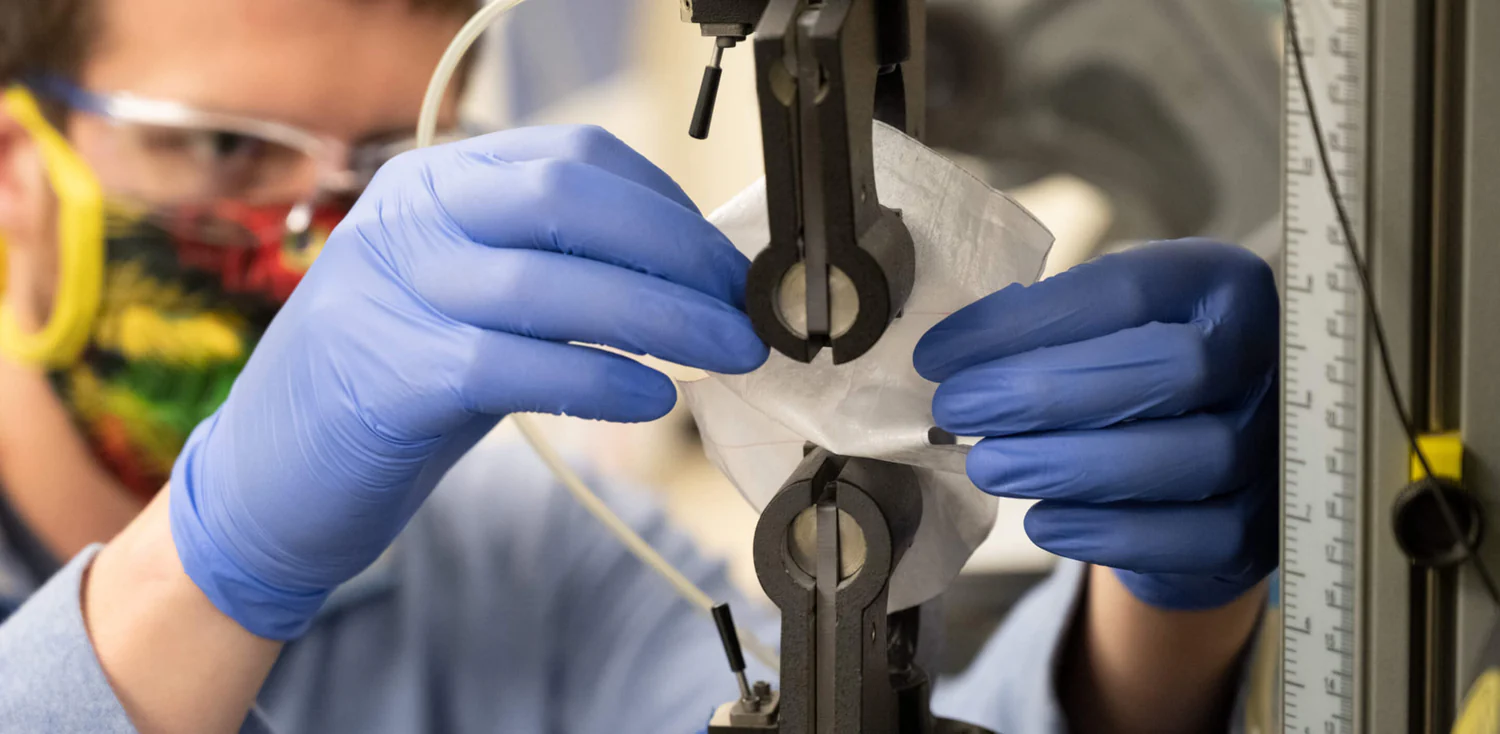
Ultimate Industrial Fabric Testing Services – Kiyo R&D LAB’s NABL-Certified Performance Analysis

Conclusion

Industrial fabrics work silently in the background, holding loads, protecting equipment, filtering fluids, and keeping people safe. To rely on them, you need more than visual inspection or supplier claims—you need measurable proof of performance.

With industrial fabric testing services – Kiyo R&D LAB, you get NABL-accredited, standards-based, and professionally interpreted test results that support quality, safety, and long-term reliability. Whether you are a manufacturer, buyer, project engineer, or student, proper fabric testing is a smart investment that prevents failures and strengthens your product offering.

If your fabric is used in demanding industrial applications, testing is not optional— it’s essential. Kiyo R&D Lab is equipped to help you prove that your fabric can handle the job.

Call Now Button