
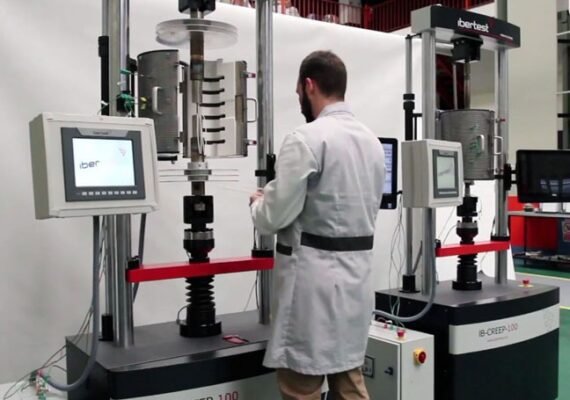
The Hidden Threat: Understanding Creep and Its Consequences
Creep is a time-dependent deformation of a material when subjected to a constant load below its yield strength, especially at elevated temperatures. Think of a rubber band that’s stretched for months; it never quite goes back to its original shape. Metals and plastics do the same, but much more slowly, and often at temperatures that wouldn’t cause immediate melting.
Why Creep is a “Silent Killer” in Engineering:
- Catastrophic Failure: Creep doesn’t just deform; it can reduce the cross-sectional area of a component, concentrating stress until it eventually fractures, often without warning.
- Dimensional Instability: Even minor creep can compromise the fit and function of precision parts, leading to misalignment, leaks in seals, or loosening of fasteners.
- Reduced Lifespan: Components designed for a 10-year lifespan might fail in 5 if their creep resistance isn’t properly understood and accounted for.
- Safety Hazards: In pressure vessels, power generation, and aerospace, creep failure can have devastating consequences for human life and environmental safety.
This is why, for any product expected to endure long-term stress, particularly in harsh environments, comprehensive creep resistance testing in mechanical properties services in India is non-negotiable.
The Science Behind Creep Testing: Measuring the Unseen Stretch
Creep testing is a meticulous, long-duration experiment designed to accelerate and observe this slow deformation process. Unlike simple tensile strength tests that measure instantaneous failure, creep tests apply a constant load and often constant, elevated temperature, then monitor the material’s elongation over time.
What Creep Testing Reveals:
- Creep Rate: How fast the material is deforming under specific conditions (load and temperature).
- Creep Rupture Time: How long the material can sustain a given load and temperature before breaking.
- Material Behavior: Helps identify optimal materials for high-temperature, high-stress applications.
- Design Validation: Provides data essential for engineers to calculate safe operating limits and predict component lifespan.
The data gathered from creep tests is critical for validating material selections, optimizing designs, and ensuring compliance with stringent industry standards.
Key Creep Test Methods at Kiyo R&D Lab
At Kiyo R&D Lab, we utilize specialized, precisely controlled creep testing machines and furnaces to conduct these vital long-term experiments according to international standards (ASTM, ISO, etc.). When you seek creep resistance testing in mechanical properties services in India – Kiyo R&D Lab, you are leveraging advanced capabilities:
1. Uniaxial Creep Test (ASTM E139)
This is the most common method for determining the creep characteristics of metals and alloys.
- What it does: A test specimen (typically a metal bar) is subjected to a constant tensile (pulling) load at a constant, elevated temperature within a specialized furnace. An extensometer precisely measures the elongation of the specimen over extended periods (hours, days, or even weeks).
- The Result: Provides a detailed “creep curve” showing three distinct stages of deformation (primary, secondary, and tertiary creep), creep rate, and rupture time. This is fundamental for understanding high-temperature material behavior.
2. Creep Rupture Test
Often conducted alongside or as a primary output of the uniaxial creep test, focusing on failure.
- What it does: Similar to the uniaxial creep test, but the primary focus is on determining the time until the material completely fractures under specified conditions. Higher loads or temperatures lead to shorter rupture times.
- The Result: Essential for critical components where sudden failure is unacceptable, allowing designers to set safe operating limits based on rupture data.
3. Creep for Polymers and Plastics (ASTM D2990)
While often associated with metals, plastics also exhibit significant creep, especially at room temperature or slightly elevated temperatures.
- What it does: Plastic specimens are subjected to a constant flexural (bending) or tensile load, and their deformation is monitored over time.
- The Result: Helps evaluate the long-term dimensional stability of plastic components used in structural applications, automotive interiors, or consumer goods where constant stress (e.g., loaded shelves, spring-loaded components) is present.
Industry Applications Driving Demand in India
As India’s industrial landscape grows, the demand for certified creep resistance testing in mechanical properties services in India is soaring across vital sectors:
- Power Generation: Crucial for components in thermal power plants (boiler tubes, turbine blades) that operate at extremely high temperatures and pressures for decades.
- Aerospace & Defense: Essential for engine components, landing gear, and structural parts that experience sustained stress and thermal cycles.
- Oil & Gas: Testing pipeline materials, pressure vessel components, and drilling equipment that operate under immense pressure and varying temperatures.
- Automotive: Evaluating engine components, exhaust systems, and high-performance plastics in areas exposed to continuous heat and stress.
- Construction: Assessing materials used in long-span structures and specialized high-temperature applications.
Why Choose Kiyo R&D Lab for Creep Resistance Testing?
When the safety, reliability, and lifespan of your products are on the line, choosing a trusted and accredited testing partner is paramount. Kiyo R&D Lab offers unparalleled advantages:
1. NABL / ISO 17025 Accreditation
Our lab operates under the stringent guidelines of NABL/ISO 17025. This accreditation signifies that our creep testing equipment is meticulously calibrated, our procedures are globally standardized, and our test reports are recognized and accepted worldwide. You get defensible, verifiable data that meets international quality and regulatory demands.
2. Advanced Testing Facilities
We boast state-of-the-art creep testing machines and high-temperature furnaces capable of maintaining precise conditions for extended durations. Our facilities are designed to handle a wide range of materials and test requirements, ensuring accurate and reproducible results.
3. Expert Metallurgists and Material Scientists
Our team comprises highly experienced metallurgists and material scientists who understand the complex mechanisms of creep. We don’t just provide data; we offer insightful analysis, helping you understand the implications of the results and make informed material selection or design modifications.
4. Consultative Partnership
We believe in a collaborative approach. Our experts work with your R&D and engineering teams to define the most relevant test parameters, ensuring the data directly addresses your specific application needs and helps you optimize product performance and longevity.