FLAMMABILITY TESTING GUIDE
How much oxygen does a plastic, rubber, cable sheath or fabric need before it will keep burning on its own? The limiting oxygen index (LOI) answers that question with a single, repeatable number. It is one of the most widely used small-scale flammability tests in the polymer, wire and cable, automotive, railway and electronics industries, and a quick way to compare how well a flame-retardant formulation is actually working.
In this guide, the team at Kiyo R&D Lab explains what the LOI value means, how the oxygen index test is performed under ASTM D2863 and ISO 4589-2, what typical values look like for common materials, which factors change the result, and how manufacturers in Chennai and Sriperumbudur use the data for material selection, quality control and specification compliance.
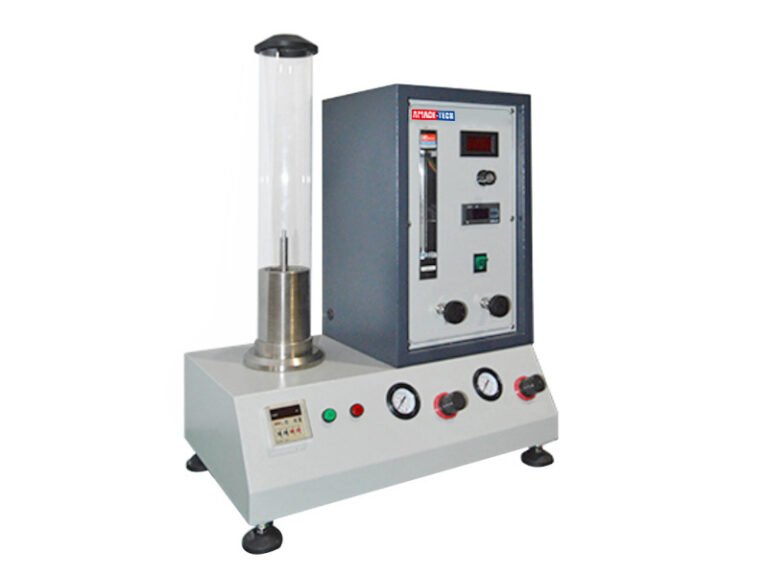
Everything you need to know about oxygen index flammability testing
The limiting oxygen index is the minimum concentration of oxygen, expressed as a volume percentage, in a flowing mixture of oxygen and nitrogen that will just support flaming combustion of a material under specified test conditions. A small specimen is held vertically inside a glass chimney, ignited at the top, and the oxygen level is adjusted up and down until the lowest concentration that keeps it burning is found.
THE FORMULA
LOI (%) = [O2] / ([O2] + [N2]) × 100
where [O2] and [N2] are the volumetric flow rates of oxygen and nitrogen at the critical burning point.
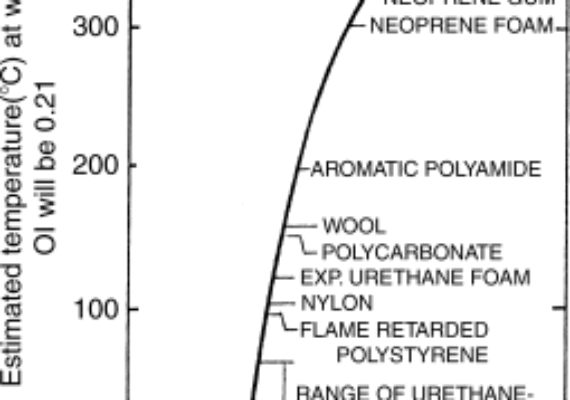
Ordinary air contains about 20.9% oxygen. That gives the result a very practical meaning: a material with an LOI below 21 can keep burning in normal air once ignited, while a material with a value comfortably above 21 needs an oxygen-enriched atmosphere to sustain a flame and tends to self-extinguish when the ignition source is removed.
Because the test is precise, inexpensive and needs only small specimens, it is ideal for ranking materials, checking the effect of flame-retardant additives, verifying incoming raw material batches and proving compliance with cable, railway and product specifications.
The method below follows the general procedure of ASTM D2863 and ISO 4589-2 (ambient temperature). Exact specimen type, ignition method and burning criteria are selected from the standard based on your material and specification.
Specimen preparation: Test bars are moulded or cut to the dimensions required by the standard. A common self-supporting plastic specimen is about 80–150 mm long, 10 mm wide and 4 mm thick; films, sheets and flexible materials use different specimen types and a support frame.
Conditioning: Specimens are conditioned in a standard laboratory atmosphere (typically 23 °C and 50% relative humidity) so that moisture content does not distort the result.
Mounting in the chimney: The specimen is clamped vertically in the centre of a heat-resistant glass column. A metered oxygen–nitrogen mixture flows upward through a bed of glass beads so the gas passes the specimen at a uniform velocity (around 40 mm/s).
Ignition: A small propane flame is applied to the top of the specimen – either to the top surface only (top-surface ignition) or down the vertical faces (propagating ignition) – for a set time, then removed.
Observing the burn: The burning time and burned length are recorded. A typical pass/fail criterion is whether the specimen keeps burning for 180 seconds or burns down 50 mm from the top, whichever comes first.
Up-and-down calculation: The oxygen concentration is raised after a specimen extinguishes and lowered after it burns. This staircase sequence continues on fresh specimens, and the final limiting oxygen index is calculated statistically from the series, usually reported to one decimal place.
A higher value means the material is harder to keep alight. As a broad rule of thumb used across the industry:
Below 21%
Flammable – can continue burning in normal air.
21% – 28%
Slow-burning to self-extinguishing in air.
Above 28%
Generally regarded as flame-retardant.
| Material | Approx. LOI (%) | Behaviour in Air |
|---|---|---|
| Polyethylene (PE) | 17 – 18 | Burns readily |
| Polypropylene (PP) | 17 – 18 | Burns readily |
| Polystyrene / ABS | 18 – 19 | Burns readily |
| Cotton | about 18 | Burns readily |
| Nylon 66 (PA66) | 23 – 26 | Slow-burning / self-extinguishing |
| Polycarbonate (PC) | 25 – 27 | Self-extinguishing |
| PEEK | about 35 | Flame-retardant |
| Rigid PVC | 45 – 49 | Flame-retardant |
| PTFE | above 90 | Highly flame-resistant |
Values are approximate literature ranges for unfilled grades. Actual results depend on the grade, additives, fillers and specimen thickness – which is exactly why testing your own material matters.
Kiyo R&D Lab carries out oxygen index testing on a wide range of polymer-based materials and finished-product samples:
PP, PE, ABS, PC, PA, PBT and blends – virgin, recycled and filled grades.
Halogen-free and halogenated FR masterbatches and compounds during development.
PVC, XLPE and LSZH insulation and sheathing compounds, including FRLS grades.
EPDM, neoprene, silicone and TPE parts, seals, gaskets and hoses.
Epoxy, phenolic, polyester and glass-fibre reinforced laminates.
PU, PE and EVA foams for seating, insulation and packaging.
Thin films, laminates and flexible sheets using the appropriate specimen type.
Technical textiles, upholstery, coated fabrics and protective clothing materials.
The test is harmonised internationally, so results from ASTM and ISO methods are broadly comparable when the same specimen type and ignition procedure are used.
ASTM ISO IS (BIS) EN
| Standard | What It Covers | Typical Use |
|---|---|---|
| ASTM D2863 | Minimum oxygen concentration to support candle-like combustion of plastics | Plastics, films, cellular materials, material datasheets |
| ISO 4589-1 | General guidance on the oxygen index method | Background for Parts 2 and 3 |
| ISO 4589-2 | Oxygen index test at ambient temperature | Plastics, railway materials (EN 45545-2), global OEM specs |
| ISO 4589-3 | Elevated-temperature test and temperature index | Materials exposed to heat in service |
| IS 10810 (Part 58) | Oxygen index test for cable insulation and sheath | Indian power and control cables, FRLS compliance |
| Customer specifications | OEM or project-specific minimum oxygen index limits | Automotive, electrical, defence and infrastructure tenders |
Oxygen index testing is often combined with other flammability checks such as glow wire (IEC 60695-2 series) and UL 94 vertical/horizontal burning, since each method looks at a different aspect of fire behaviour.
Keep in mind that the limiting oxygen index is a controlled small-scale laboratory test. It is excellent for ranking materials and quality control, but it does not on its own predict how a full product will behave in a real fire scenario.
FRLS and LSZH cable specifications commonly set a minimum oxygen index for insulation and sheath compounds.
Interior trims, battery housings, connectors and wiring harness components.
Seating, panels, flooring and cables assessed to fire safety requirements.
Enclosures, switchgear parts, PCB laminates and appliance housings.
Insulation foams, pipes, conduits, roofing membranes and panels.
Protective clothing, upholstery and technical fabrics with FR finishes.
Explore related services: Material Testing Laboratory, Thermal Accelerated Properties, Electrical Testing Services and Automotive Plastics Testing Services.
Send your samples to either of our two laboratories. Our team will help you choose the right standard, specimen type and number of samples before testing begins.
Our main laboratory at Chitlapakkam, Chrompet – convenient for manufacturers across Chennai, Guindy, Ambattur, Tambaram and the southern suburbs.
Call Us WhatsApp UsLocated in the heart of the automotive and electronics manufacturing belt – ideal for OEMs and Tier-1 suppliers in Oragadam, Sriperumbudur and Irungattukottai.
Call Us WhatsApp UsExplore all our capabilities at www.kiyorndlab.com.
The limiting oxygen index turns a complex question – how easily does this material keep burning? – into one clear, comparable number. Whether you are developing a flame-retardant compound, qualifying a cable sheath for FRLS requirements or checking that a supplier’s batch still meets specification, oxygen index data gives you a fast and reliable basis for decisions.
Kiyo R&D Lab supports manufacturers across Chennai and Sriperumbudur with oxygen index testing alongside a wide range of mechanical, thermal, electrical and flammability tests. Talk to our team about your material and specification today.