Your guide to reciprocating abraser testing Services at Kiyo R&D Lab
How well does your coating, plastic, or finished surface survive repeated rubbing in real use? Reciprocating abraser testing services answer that question by simulating the back-and-forth wear that products face every day — a wiper on a screen, a hand on a control panel, a seal against a mating part. At Kiyo R&D Lab in Chennai, we run controlled reciprocating wear tests that turn abrasion resistance into hard, defensible numbers.
This service fits naturally alongside our broader material testing capability — so when wear reveals a coating problem, we can follow up with FTIR to identify the material and TGA to check its thermal stability, all under one roof. Whether you are qualifying a supplier, validating a new formulation, or investigating field failures, our team delivers repeatable results you can act on with confidence.
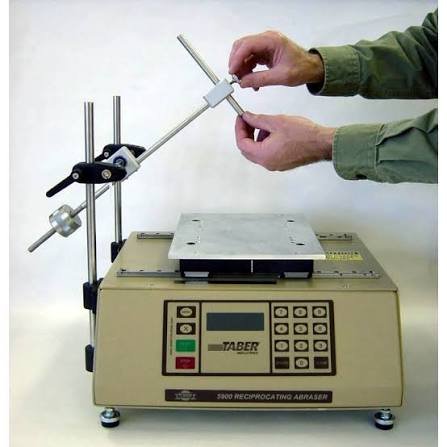
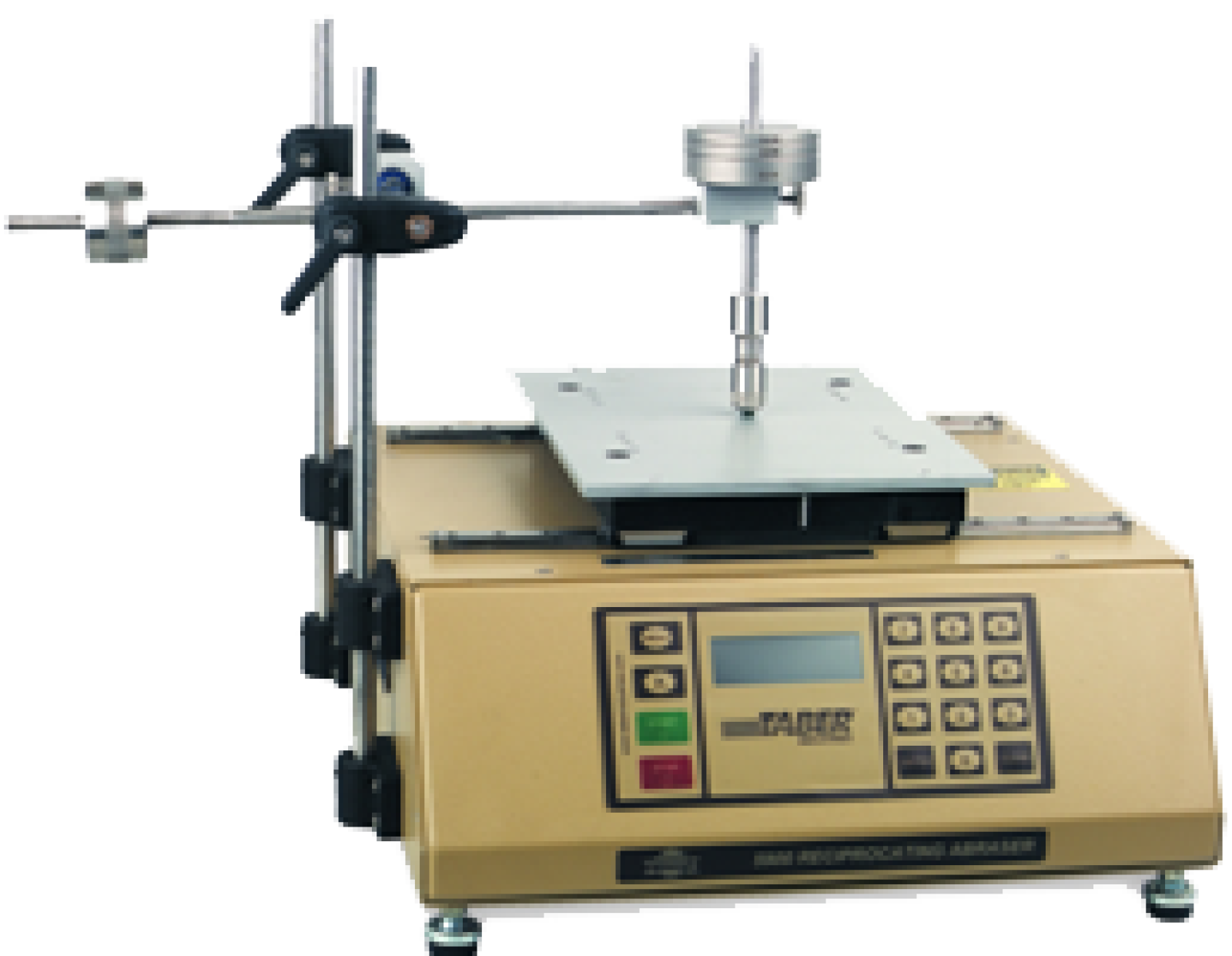
A reciprocating abraser drags a loaded wear tip or abradant back and forth across a sample in a controlled linear stroke. By fixing the load, stroke length, speed, and cycle count, our reciprocating abraser testing services reproduce real-world rubbing precisely — and let you compare one material or coating against another on equal terms.
| What We Report | Why It Matters |
|---|---|
| Mass / thickness loss | Quantifies how much material is worn away |
| Cycles to failure | Predicts service life under repeated contact |
| Coating breakthrough | Shows when a finish exposes the substrate |
| Surface appearance change | Gloss loss, scratching, marring assessment |
Where a failure needs a root cause, reciprocating abraser testing services connect directly to the rest of our lab: FTIR identifies the worn or transferred material, while TGA checks filler content and thermal stability that can influence wear behaviour.
The value of professional reciprocating abraser testing services lies in control. Every parameter is documented so results are reproducible and audit-ready — essential when data must hold up in a supplier dispute, a warranty claim, or a design sign-off. You get numbers you can defend, not impressions.
Because this sits within our full material testing portfolio, a single sample can move seamlessly from wear testing to chemical and thermal analysis without repeated logistics or re-sampling errors.
Abrasion resistance is not a claim — it is a measurement. With Kiyo R&D Lab’s reciprocating abraser testing services, you get controlled, repeatable wear data backed by ASTM/ISO methods and, where applicable, NABL-accredited reporting. And because wear rarely tells the whole story alone, our material testing, FTIR, and TGA capability lets us turn a wear result into a full root-cause answer.
Send us your samples and application details, and our team in Chennai will set the right parameters and get you defensible results fast.
Call: 90420 86986 | 90876 86986
Web: www.kiyorndlab.com
Our reciprocating abraser testing services are run to recognised ASTM and ISO wear/abrasion methods, with test parameters set to match your application. Accredited reporting is available for methods within our NABL scope; we confirm the exact status for your specific test before you commit.
Reciprocating (linear) abrasion mimics back-and-forth rubbing along a straight path, while rotary abrasion uses a rotating disc. Reciprocating abraser testing services are the better match when the real-world motion is a wipe or stroke rather than a spin.
Coated panels, plastic parts, films, laminates, printed surfaces and finished components. As part of our broader material testing services we can also prepare and condition samples to the standard before wear testing.
Yes. After the wear run, FTIR identifies the coating or transferred material and TGA reveals filler and thermal factors — so our reciprocating abraser testing services deliver a root cause, not just a pass or fail.
Most reciprocating abraser testing services are completed within a few working days once samples and parameters are confirmed. Rush handling is available on request.