
Flexural strength and modulus tell you how a plastic part behaves under bending load — essential data for everything from housings to structural components. ASTM D790 testing chennai manufacturers rely on measures exactly that, using a three-point bend to report flexural strength, modulus, and stress at a given strain. At Kiyo R&D Lab, we run ASTM D790 testing chennai businesses can trust, with calibrated equipment and clear, defensible reports.
Whether you are qualifying a new grade, verifying an incoming batch, or investigating why a part failed under load, accurate ASTM D790 testing chennai gives you comparable, standard-aligned flexural data. Our team handles specimen preparation, conditioning, and testing in-house so your results hold up to any customer audit.
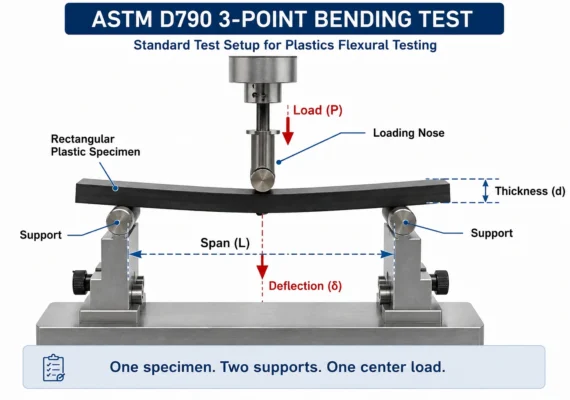
Your guide to ASTM D790 flexural testing at Kiyo R&D Lab
ASTM D790 is the standard for the flexural properties of unreinforced and reinforced plastics, using a three-point bend. A proper astm d790 testing chennai service reports the full set of flexural results and applies the correct procedure for your material. The table below shows what we report and links to our detailed pages.
| What We Report | Meaning |
|---|---|
| Flexural strength | Max stress at the outer fibre before failure |
| Flexural modulus | Stiffness in bending |
| Stress at 5% strain | For materials that don’t break |
| Specimen size & setup | Dimensions, span-to-depth ratio & speed |
| Procedures A & B | Two strain rates for different materials |
Procedure A uses a strain rate of 0.01 mm/mm/min and Procedure B uses 0.10 — correct astm d790 testing chennai means picking the one your specification requires, with the right span-to-depth ratio.
Many plastic parts carry bending loads in service, so flexural strength and modulus are often more relevant than tensile numbers alone. Reliable astm d790 testing chennai lets you compare grades on equal terms and catch an out-of-spec batch before it reaches production.
For manufacturers around Chennai, having this capability close by means faster turnaround and quicker corrective action than sending specimens out of state.
Correct flexural results depend on the right procedure, span-to-depth ratio, and specimen geometry. With Kiyo R&D Lab’s astm d790 testing chennai service, you get accurate flexural strength and modulus data on calibrated equipment, with NABL-accredited reporting where applicable.
Send us your material and specification, and our Chennai team will set the right procedure, prepare specimens, and get you defensible results fast.
Call: 90420 86986 | 90876 86986
Web: www.kiyorndlab.com
Our astm d790 testing chennai service uses standard rectangular bar specimens, with dimensions and support span set by the material thickness. Accredited reporting is available for methods within our NABL scope; we confirm the exact status for your test before you commit.
They use different strain rates (0.01 vs 0.10 mm/mm/min). As your astm d790 testing chennai provider, we select the procedure your specification requires.
Both are three-point flexural tests and give comparable results, but differ in specimen details and test speed. We can run to whichever standard your buyer specifies.
Standard bars, which we can prepare from your sheets or mouldings. Our astm d790 testing chennai service confirms the exact specimen size and count when we scope your job.
Most flexural jobs are completed within a few working days once specimens and requirements are confirmed. Rush handling is available on request.