
A bracket that bends under load, a housing that cracks when clamped, a moulded panel that sags over time: bending is one of the most common ways plastic parts fail. Dependable flexural strength testing in Chennai shows how much bending load a material can take, and how stiff it stays, before it deforms or breaks.
At Kiyo R&D Lab, we measure flexural properties on a universal testing machine and report the results against the applicable standard. Our team combines NABL-aligned methods with expert interpretation, so your decisions rest on evidence, not guesswork.
Your guide to flexural testing at Kiyo R&D Lab
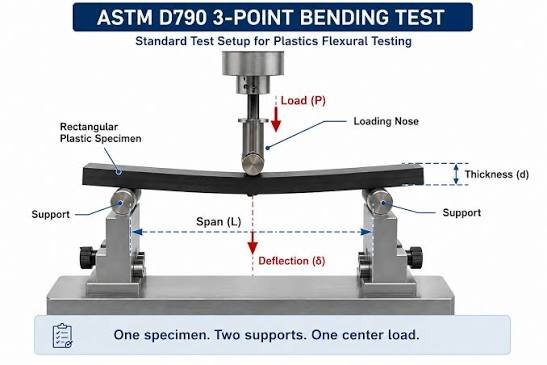
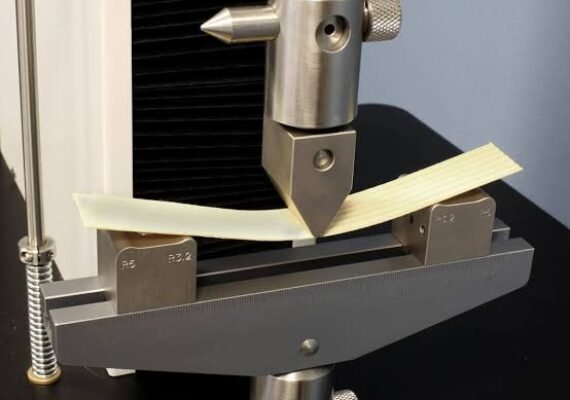
In a flexural test, a bar of material rests on two supports and a load is applied at its centre until it bends or breaks. Good flexural strength testing in Chennai reports three values: flexural strength (the stress at failure or at the set strain limit), flexural modulus (stiffness), and flexural strain (how far the material bends). ASTM D790 testing is the method most often requested for unreinforced and reinforced plastics and electrical insulating materials.
The table below summarises the typical set-up. Exact dimensions, speeds and limits follow the standard edition and your customer specification.
| Parameter | Typical ASTM D790 Set-Up |
|---|---|
| Test type | Three-point bending on a universal testing machine |
| Typical specimen | Rectangular bar, about 127 × 12.7 × 3.2 mm |
| Support span | About 16 times the specimen depth |
| Test speed | Procedure A about 0.01 mm/mm/min; Procedure B about 0.10 mm/mm/min |
| Results reported | Flexural strength, modulus and strain |
| Specimens | At least five per sample |
Because the span, speed and thickness all affect the result, consistent set-up is what makes flexural strength testing in Chennai comparable from batch to batch and from lab to lab.
Controlling these factors is what turns flexural strength testing in Chennai into reliable design data. For broader material work, see our plastic testing laboratory page.
From grade selection to batch checks, good decisions start with good data. As a trusted partner for flexural strength testing in Chennai, Kiyo R&D Lab delivers ASTM D790 testing and related plastic tests under one roof, backed by ASTM/ISO methods and NABL-accredited reporting where applicable.
Tell us your material, specimen details and the specification you must meet. Our team will plan the right set-up and get you defensible results from flexural strength testing in Chennai you can rely on.
Call: 90420 86986 | 90876 86986
Web: www.kiyorndlab.com
Our flexural strength testing in Chennai follows ASTM D790, and ISO 178 where your specification calls for it. Accredited reporting is available for methods within our NABL scope; we confirm the exact status for your test before you commit.
Kiyo R&D Lab offers flexural testing on a universal testing machine, with results reported against the standard you name. Send your material, thickness and specification and we will confirm the method and timeline.
Both are three-point bending methods for plastics, but they differ in specimen size, test speed and calculation details, so their values are not always interchangeable. Use the one named in your specification.
Yes. Glass-filled and other reinforced plastics are common in our flexural strength testing in Chennai. For fibre-reinforced composites, a different standard may be more suitable, and we can advise on the right method for your material.
The standard calls for at least five specimens per sample, and extra pieces help if a retest is needed. Most flexural tests complete within days once samples arrive, and we confirm the timeline after reviewing your specification.