
One simple number tells a surprising amount about a thermoplastic: how easily it flows when molten. That number comes from melt flow index testing, and it is one of the most widely used quality checks in the plastics industry — fast, repeatable, and closely tied to processability and molecular weight. This guide explains the test procedure to ASTM D1238 and where the result is actually used.
At Kiyo R&D Lab, melt flow index testing is a routine part of our plastics work, from incoming resin checks to failure investigations. Understanding how the test works helps you read an MFI value correctly and know what it can — and cannot — tell you.
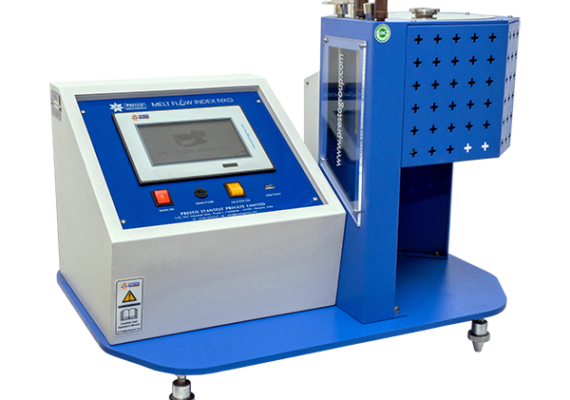
Your guide to melt flow index testing at Kiyo R&D Lab
Melt flow index testing follows a precise, standardised sequence — the result is only valid if every step is controlled. The table below walks through the procedure to ASTM D1238.
| Step | What Happens |
|---|---|
| 1. Set conditions | Temperature & load per the material spec |
| 2. Charge barrel | Load pellets, preheat for a set time |
| 3. Apply weight | Piston & weight force melt through the die |
| 4. Collect extrudate | Cut timed segments of flowing polymer |
| 5. Weigh & calculate | Report mass per 10 min (g/10 min) |
The result depends entirely on the temperature and load used, so melt flow index testing must always state the condition alongside the value. For the full service and standard conditions, see our ASTM D1238 MFI testing page.
A high melt flow value means the polymer flows easily — lower molecular weight; a low value means the opposite. That simple relationship is why melt flow index testing is used to confirm grade, detect degradation or contamination, and check batch-to-batch consistency, all from a few grams of pellets.
It is an indirect, comparative measure rather than an absolute molecular-weight figure — but for everyday quality control, that is exactly what makes it so useful.
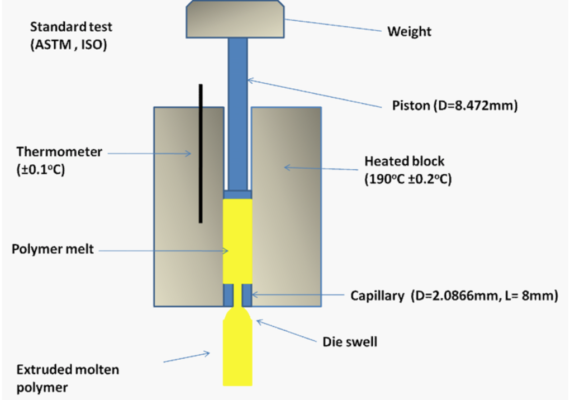
Melt flow is quick to measure but easy to get wrong if the conditions drift. With Kiyo R&D Lab’s melt flow index testing, you get condition-correct results on calibrated equipment to ASTM D1238, with NABL-accredited reporting where applicable — reliable enough to classify a grade or clear a batch.
Send us your pellets and the specification condition, and our Chennai team will run the test and give you a defensible result fast.
Call: 90420 86986 | 90876 86986
Web: www.kiyorndlab.com
Melt flow index testing appears at almost every stage of the plastics value chain, because it is fast and tells you so much about processability. Accredited reporting is available for methods within our NABL scope.
It measures the mass of molten polymer that flows through a standard die in ten minutes, under a set temperature and load — an indirect indicator of molecular weight and flow.
Because the value changes with temperature and load. A melt flow index testing result is meaningless without its condition (e.g. 230 °C / 2.16 kg), so we always report both.
Yes. A shift in flow versus the expected value is a quick flag for degradation, contamination, or excessive regrind, which is why melt flow index testing is a front-line QC check.
A few grams of pellets or granules is usually enough. We confirm the quantity and test condition when we scope your job.