Recycled plastic is only as good as its consistency — and that is exactly where it struggles. Every reprocessing cycle degrades the polymer a little, so melt flow drifts batch to batch far more than with virgin resin. MFI testing for recycled plastics is the fastest, cheapest way to catch that drift before it ruins a moulding run. At Kiyo R&D Lab, we help recyclers and compounders verify every lot of regrind to ASTM D1238.
Whether you are grading incoming scrap, blending regrind with virgin, or selling recycled pellets to a spec, MFI testing for recycled plastics gives you a single number that flags degradation, contamination, and inconsistency. Our team runs the test in-house and gives you clear, defensible reports.
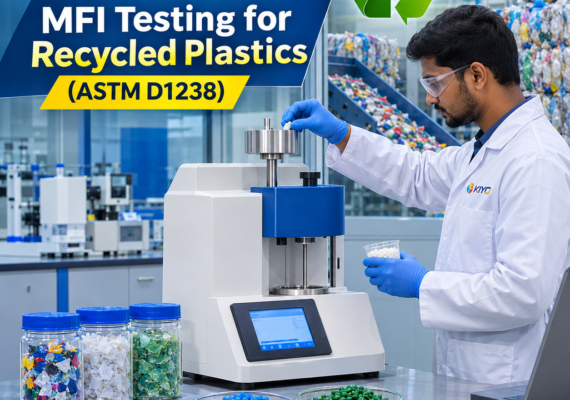
Your guide to MFI testing for recycled plastics at Kiyo R&D Lab
Virgin resin arrives with a known, stable grade. Recycled material does not — which is exactly why MFI testing for recycled plastics matters more than for virgin. The table below shows what each reprocessing step does to melt flow and why the test catches it.
| Issue in Regrind | Effect on Melt Flow |
|---|---|
| Thermal degradation | MFI rises (chains shorten) |
| Cross-linking / contamination | MFI drops or scatters |
| Mixed polymer types | Erratic, non-repeatable values |
| Batch-to-batch variation | Wide MFI spread across lots |
A quick MFI check turns an unknown lot of regrind into a graded, specified material. Routine MFI testing for recycled plastics is what lets you blend regrind with virgin confidently, at a known ratio.
Recyclers who test earn a price premium: a graded, MFI-verified pellet sells for more than unverified regrind, because the buyer can process it with confidence. MFI testing for recycled plastics is the simplest way to move up that value ladder — one number that proves your material is consistent.
It also protects you in disputes: when a customer blames your regrind for a bad run, a documented MFI record on the lot you shipped is your evidence.
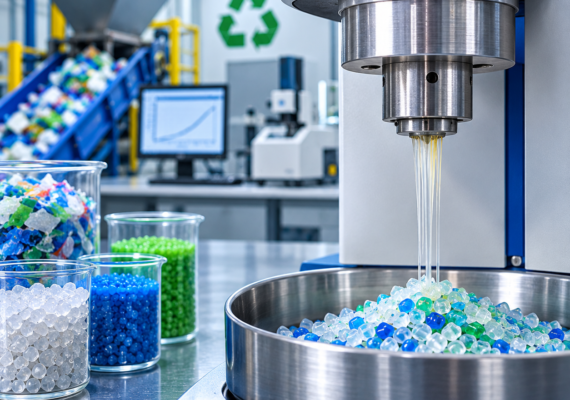
Consistency is what separates sellable recycled pellet from risky scrap — and melt flow is the quickest way to prove it. With Kiyo R&D Lab’s MFI testing for recycled plastics, you get condition-correct results to ASTM D1238 on every lot, with NABL-accredited reporting where applicable.
Send us a sample from each batch of regrind and your target grade, and our Chennai team will test it and give you a clear accept/reject answer fast.
Call: 90420 86986 | 90876 86986
Web: www.kiyorndlab.com
Our MFI testing for recycled plastics follows ASTM D1238 (and ISO 1133), using the temperature and load for your polymer type. Accredited reporting is available for methods within our NABL scope; we confirm the exact status before you commit.
Because each heat cycle degrades the polymer, so regrind varies far more. MFI testing for recycled plastics catches that variation lot by lot, which virgin resin rarely needs.
Indirectly, yes. Knowing the MFI of both your virgin and regrind lets you target a blend that keeps the mix within your processing window.
Not always — it depends on your spec. But a value far from the expected range is a red flag for degradation or contamination, which is why MFI testing for recycled plastics is a front-line check.
A few grams of pellets or regrind per lot. We confirm the quantity and test condition when we scope your job.