
When a European or global customer asks for tensile data, they usually want it to one standard: ISO 527. It’s the international method for pulling a plastic specimen and measuring its strength, stiffness, and stretch. A tensile test on plastics iso 527 defines gives you strength, modulus, and elongation numbers that buyers worldwide accept. Kiyo R&D Lab performs this test with precision, so your results travel wherever your product does.
From rigid and reinforced plastics to films and flexible grades, our team runs the tensile test on plastics iso 527 demands and delivers accurate tensile data, supporting analysis, and clear, audit-ready reports you can rely on.
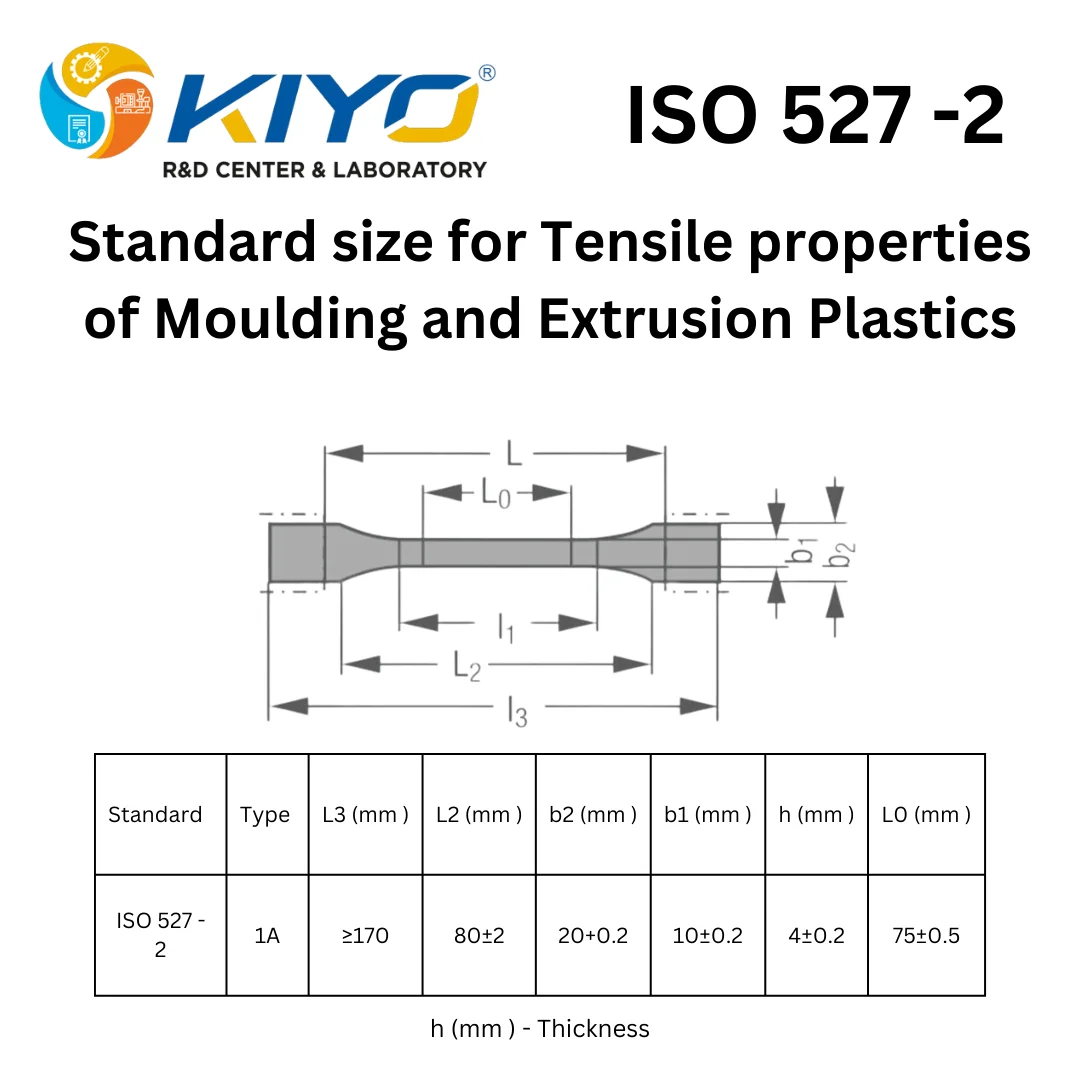
Your complete guide to ISO 527 tensile testing at Kiyo R&D Lab
ISO 527 is the international standard for determining the tensile properties of plastics. A dumbbell-shaped specimen is gripped at both ends and pulled apart at a controlled speed while force and extension are recorded. From that data, the standard derives tensile strength, modulus, and elongation. Running a tensile test on plastics iso 527 style produces the strength and stiffness numbers used on data sheets and in specifications across the world.
The standard comes in parts: ISO 527-1 sets the general principles, while ISO 527-2 covers moulding and extrusion plastics, and further parts address films and composites. Because it’s the global reference, results from a tensile test on plastics iso 527 specifies are comparable between suppliers and customers everywhere.
When you need a tensile test on plastics iso 527 requires, we measure every key property on the correct specimen type for your material.
Peak stress before break.
Stiffness (Young’s modulus).
At yield & at break.
Onset of permanent set.
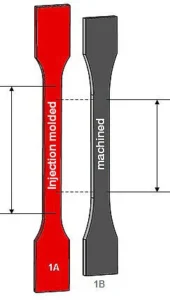
1A, 1B, 5A, 5B.
Standard temp & humidity.
| Type | Preparation | Best For |
|---|---|---|
| Type 1A | Directly moulded | Moulding compounds |
| Type 1B | Machined from sheet | Extruded / cast sheet |
| Type 5A | Small dumbbell | Limited material |
| Type 5B | Smallest dumbbell | Films & thin sheet |
Knowing how ISO 527 relates to other tensile standards helps you request the right one — and we test to whichever your customer specifies.
ISO ASTM
| Standard | Material | Note |
|---|---|---|
| ISO 527 | Plastics | The international tensile standard |
| ASTM D638 | Plastics | US equivalent, differs slightly |
| ISO 527-2 | Moulding plastics | Most common part |
| ISO 527-3 | Films & sheets | Thin materials |
| ISO 527-4/5 | Composites | Fibre-reinforced |
Need the US standard instead? We also run ASTM D638 — just tell us which your specification calls for.
Based in Chennai with branches in Chrompet and Oragadam, Kiyo R&D Lab makes professional ISO 527 tensile testing easy to access for the Chennai–Oragadam industrial corridor, with convenient drop-off and courier-friendly collection.
Need a tensile test on plastics iso 527 covers, done right? Our facilities test all specimen types with clear, accurate, export-ready reporting.
📞 Call 90420 86986 💬 Request a QuoteExplore all our capabilities at www.kiyorndlab.com.
When export specs, quality, and material selection are on the line, trust a lab that delivers clear answers. For a tensile test on plastics iso 527 sets the rules for, we combine correct specimen preparation, the exact standard method, and expert interpretation to give you tensile data you can stand behind.
From a single strength check to full material qualification, the team at Kiyo R&D Lab is ready to help. Reach out today and turn your sample into a reliable, audit-ready report.