
Under the bonnet, a plastic part can see 120 °C, 150 °C, or more for years — and that is where many of them quietly give up. High-temperature plastic failure is one of the most common and expensive problems in automotive components, because a material that passes at room temperature can soften, embrittle, or distort when the engine heats up. This guide explains why high-temperature plastic failure happens and how testing predicts it before a part reaches the road.
At Kiyo R&D Lab, we help automotive suppliers understand high-temperature plastic failure through thermal and mechanical testing. The causes are specific and testable — once you know them, you can select a material that survives the heat.
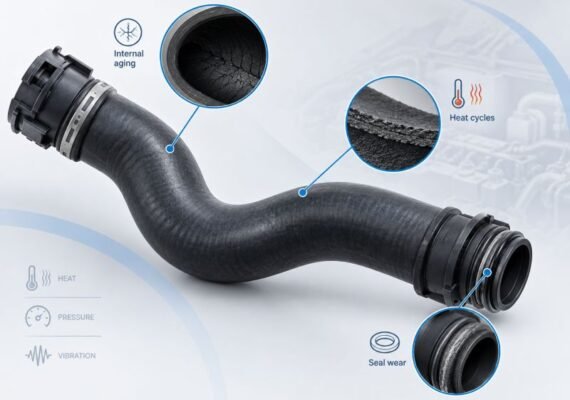
Your guide to high-temperature plastic failure at Kiyo R&D Lab
Heat attacks plastics in several distinct ways, and high-temperature plastic failure is really a family of failure modes, not one. The table below shows each mode and what it does to an automotive part.
| Failure Mode | What Happens to the Part |
|---|---|
| Softening above HDT | Loses stiffness, distorts under load |
| Thermal ageing / oxidation | Embrittles, cracks over time |
| Creep under heat + load | Slow deformation, loosening clamps |
| Loss of additives / plasticiser | Shrinkage, surface cracking |
| Approaching melting / Tg | Dimensional change, warpage |
The trap is that a part can pass every room-temperature test and still show high-temperature plastic failure in service, because the weakness only appears once the material is hot.
Most high-temperature plastic failure comes down to the wrong grade for the service temperature — an unfilled polymer where a glass-filled one was needed, or a commodity resin where a high-temperature engineering plastic was required. The under-bonnet environment is unforgiving, and the margin between “works” and “warps” can be narrow.
Testing a candidate material at its real service temperature, not just at ambient, is the only reliable way to avoid this failure after launch.
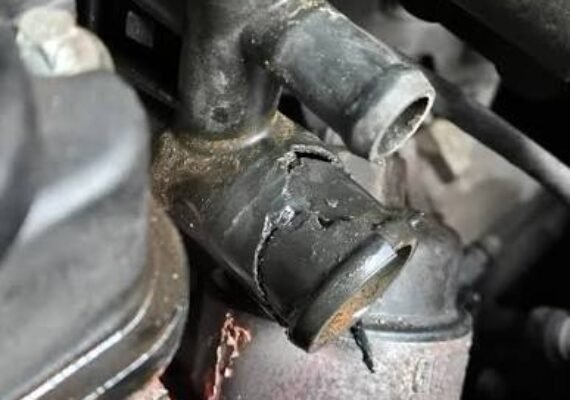
An automotive plastic part is only proven when it is tested at the temperature it will actually see. By measuring heat deflection, thermal stability, ageing, and hot mechanical properties, Kiyo R&D Lab helps you catch high-temperature plastic failure at the design stage — not after a field recall — with NABL-accredited reporting where applicable.
Tell us your part, its material, and the service temperature it faces, and our Chennai team will test it under realistic heat and tell you whether it will survive. For failure diagnosis of parts already in service, see our guide on why plastic parts fail.
Call: 90420 86986 | 90876 86986
Web: www.kiyorndlab.com
Predicting high-temperature plastic failure means testing at or above the service temperature, not only at ambient. Accredited reporting is available for methods within our NABL scope.
Because plastics soften and weaken as they heat. Room-temperature tests miss this entirely, which is why high-temperature plastic failure surprises teams who only tested at ambient.
Heat deflection temperature is the temperature at which a plastic bends under a set load. It is a first-line indicator of high-temperature plastic failure risk for a load-bearing part.
Thermal ageing accelerates heat exposure, so months of oven ageing can represent years in service, revealing embrittlement before the part ever ships.
The candidate material or the finished part, plus the service temperature and load it will see. That lets us test under realistic conditions.