
Here is a scenario that frustrates every manufacturer: the incoming resin passed every test, the certificate was clean — and the finished part still cracked in service. If the material was good, why plastic parts fail at all becomes the real question. The answer is that good material is only half the story; how the part is moulded, designed, and assembled matters just as much. This guide explains why plastic parts fail even when the raw material is sound.
At Kiyo R&D Lab, many of the failures we investigate have nothing to do with the resin itself. Understanding why plastic parts fail downstream of the material helps you stop blaming the supplier and fix the real cause.
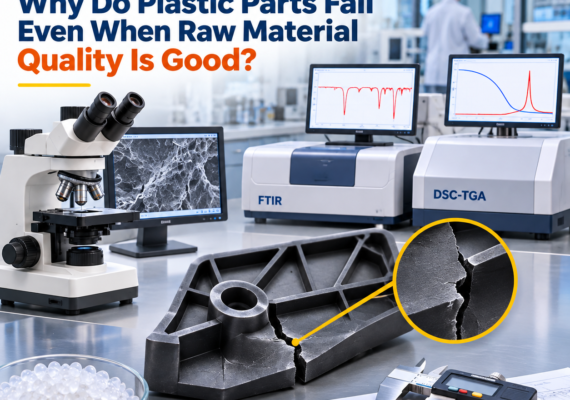
Your guide to plastic part failure at Kiyo R&D Lab
When the resin is good, why plastic parts fail comes down to what happens after the pellets arrive — in moulding, design, and use. The table below shows the common non-material causes and the clue each one leaves.
| Cause | Clue It Leaves |
|---|---|
| Moulded-in stress | Cracks away from any load point |
| Weak weld / knit lines | Crack follows a flow line |
| Process degradation (over-heat) | Brittle part from good resin |
| Sharp corners / thin walls | Crack at a stress concentration |
| Chemical / environmental attack (ESC) | Cracks where a chemical contacts stress |
| Assembly overload | Failure at a screw boss or snap-fit |
Notice that every one of these can happen with perfectly good resin. That is the key insight into why plastic parts fail: a clean material certificate does not guarantee a sound part.
Testing the raw material confirms the pellets were in spec; it says nothing about what the moulding process or design did to them. To understand why plastic parts fail, you have to examine the failed part itself — its fracture surface, its internal structure, and whether the process changed the polymer after it left the bag.
This is why a clean incoming-material report and a failed part can both be true at once — and why fixing the problem starts with analysing the part, not re-testing the resin.
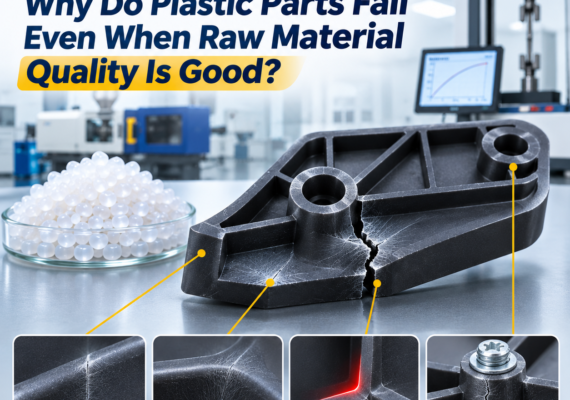
A clean material certificate and a failed part are not a contradiction — they are a clue that the problem lies in processing, design, or use. A proper failure investigation answers why plastic parts fail by examining the part itself, so you fix the true cause instead of changing a supplier who was never at fault.
Kiyo R&D Lab combines SEM, FTIR, thermal, and mechanical testing to diagnose failed plastic parts, with NABL-accredited reporting where applicable. Send us the part and what you know, and our Chennai team will find the root cause. For material-side cracking specifically, see our guide on why plastic parts crack.
Call: 90420 86986 | 90876 86986
Web: www.kiyorndlab.com
To answer why plastic parts fail when the material was good, a lab examines the failed part with several techniques — reading the fracture, checking for process degradation, and detecting environmental attack. Accredited reporting is available for methods within our NABL scope.
Absolutely. Material and part are different questions. Understanding why plastic parts fail almost always requires examining the failed part, not just re-checking the resin that made it.
Yes. Excess melt temperature, long residence time, or moisture can degrade even in-spec resin during moulding, which is a frequent reason why plastic parts fail despite a clean material report.
The failed part, un-cleaned and with the fracture untouched, plus a good part if you have one. Any notes on where and when it failed help us a lot.
A focused part-failure investigation is often completed within a few working days, depending on how many techniques the case needs.