
Every load-bearing material has a point beyond which it stops springing back and starts to deform permanently. That point is its yield strength — one of the most important numbers in material selection and design. Knowing this value tells an engineer how much stress a material can take before it is permanently bent out of shape. This guide explains what the property means, how it is calculated, and how it shows up on a stress-strain curve.
At Kiyo R&D Lab, we measure it every day as part of tensile testing on metals, plastics, and composites. Whether you are choosing a material or verifying a supplier’s claim, understanding this property helps you read a test report with confidence.
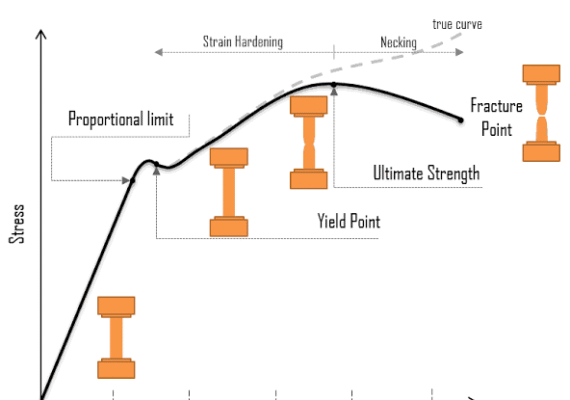
Your guide to yield strength at Kiyo R&D Lab
Yield strength is the stress at which a material begins to deform plastically — that is, permanently. Below it, the material behaves elastically and returns to its original shape when the load is removed; above it, the change is permanent. It is expressed as force per unit area:
σy = Yield Load (N) ÷ Cross-sectional Area (mm²)
Result in megapascals (MPa, or N/mm²)
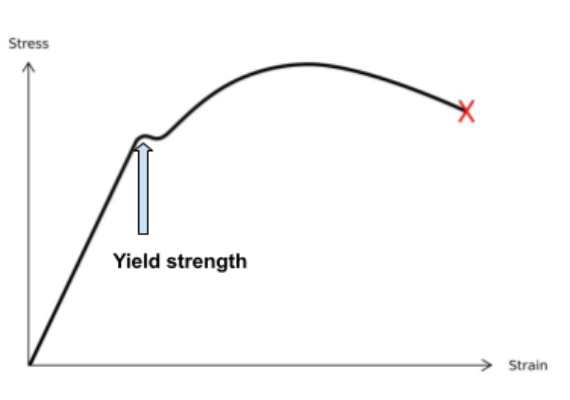
On a stress-strain graph, yield strength is where the straight elastic line starts to bend into the curved plastic region. For many metals this point is clear, but for materials without a sharp transition it is found using the 0.2% offset method — drawing a line parallel to the elastic slope, offset by 0.2% strain, and reading the stress where it crosses the curve.
That offset value is reported as the proof stress, and it is how the property is quoted for aluminium, many plastics, and other materials that yield gradually.
| Property | What It Means |
|---|---|
| Yield strength | Onset of permanent deformation |
| Tensile strength | Maximum stress before failure |
| Elastic limit | Last point of fully recoverable strain |
| Proof stress | Yield value at a set offset (e.g. 0.2%) |
In design, this is usually the limiting number: a part is sized so working stresses stay safely below it, because once a component yields it does not recover. That is why accurate yield data matters more than tensile strength alone for most structural decisions.
Datasheet values are a starting point, but the yield strength of your actual material — as processed, in your batch — is what your design and your customers depend on. A proper tensile test gives you that number with confidence, along with tensile strength and elongation from the same run.
Kiyo R&D Lab performs tensile testing on metals, plastics, and composites to ASTM and ISO methods, with NABL-accredited reporting where applicable. Send us your sample and we will give you defensible mechanical-property data you can design and certify with.
Call: 90420 86986 | 90876 86986
Web: www.kiyorndlab.com
Understanding yield strength is essential across almost every industry that relies on load-bearing materials, because it defines the safe working limit of a part.
The former is where permanent deformation begins; tensile strength is the maximum stress the material withstands before breaking. A part is usually designed to stay below the yield point.
For materials without a clear yield point, the 0.2% offset (proof stress) method defines the yield point as the stress at 0.2% permanent strain — a repeatable, agreed convention.
By a tensile test: a specimen is pulled while load and extension are recorded, and the value is read from the resulting stress-strain curve.
Megapascals (MPa) or N/mm² in metric; sometimes ksi (thousand pounds per square inch) in imperial-unit specifications.